A blog exploring the sexy, shocking, surreal, and silly side of horror films.
Showing posts with label movie. Show all posts

October 13, 2011

History Repeating: THE THING about Bad Reviews

The reviews for the prequel/remake of John Carpenter's The Thing are starting to come in. Is anyone else getting a strong feeling of deja vu here? Some THING strange is going on.

On the eve of its release, the 2011 version of The Thing is already garnering plenty of negative criticism from mainstream critics and horror critics. Funnily enough, I'm reminded of how Carpenter's The Thing was also raked over the coals and considered a flop even though it's now held as a classic of horror in the 80s.

No one can predict whether The Thing (prequel) is cursed to repeat the history of Carpenter's version, but I have noticed something peculiar going on. In particular, let's look at Vincent Canby's 1982 review of Carpenter's film for The New York Times and compare it to Brad Miska's review of the prequel for Bloody Disgusting. In both, the critics are complaining about essentially the exact same things. See for yourself.

TOO MUCH MONSTER SCREEN TIME
THE THING (1982) - "Like all such movies that don't trust themselves to keep an audience interested by legitimate dramatic means, ''The Thing'' shows us too much of ''the thing'' too soon, so that it has no place to go" (CANBY)

THE THING (2011) - "Early in The Thing, the initial creature is barely displayed. . . . Only, as the minutes pass, the filmmakers feel the need to show more and more causing an alarming amount of CGI to vomit across the screen" (MISKA)

UNREALISTIC SPECIAL EFFECTS
THE THING (1982) - "[The Thing], which opens today at the Rivoli and other theaters, is too phony looking to be disgusting. It qualifies only as instant junk." (CANBY)

THE THING (2011) - "[T]here's literally a full-on CG shot of the creature standing 12 feet tall. It looked like something out of "Gears of War" or "Doom", like re-rendered video game footage. . . . Universal's new The Thing already looks more dated than Carpenter's, and it's not even in theaters as of this writing!" (MISKA)

NO STORY TO SUPPORT EFFECTS
THE THING (1982) - "a virtually storyless feature composed of lots of laboratoryconcocted special effects" (CANBY)

THE THING (2011) - "2011 crap that's nothing more than a boring CGI promo-reel" (MISKA)

WEAK ACTING
THE THING (1982) - "Kurt Russell, Richard Dysart, A. Wilfred Bramley, T.K. Carter, Peter Maloney, David Clennon and other worthy people appear on the screen, but there's not a single character to act. All that the performers are required to do is to react with shock and terror from time to time" (CANBY)

THE THING (2011) - "It even sucks for the actors (and causes weak performances) because with CG there isn't anything physical for them to react to" (MISKA)

THE ORIGINAL IS BETTER
THE THING (1982) - "For the record, it should be immediately pointed out that this new film bears only a superficial resemblance to Howard Hawks's 1951 classic ''The Thing,'' though both were inspired by the same source material, John W. Campbell Jr.'s story ''Who Goes There?'' The Hawks film . . . is something of a masterpiece of understatement. It's also funny. The new ''Thing'' has been written with no great style by Bill Lancaster and directed by Mr. Carpenter without apparent energy or the ability to share his interest with us." (CANBY)

THE THING (2011) - "Everything that was great about the 1982 version (it was a small, claustrophobic film with strong characters and awesome special effects) is ignored" (MISKA)

Now I ask you, is history repeating? Or did they watch the same damn movie?

September 12, 2011

Fiend Without a Face (Review)

Fiend Without a Face (1958) 

Director: Arthur Crabtree

British science fiction films only flourished for a brief period of time, and British sci-fi / horror was on the scene for even less. As a result, a classic like Fiend Without a Face shines even brighter in the back catalog of genre cinema. Sincere, unexpected, and unprecedentedly grisly, Fiend Without a Face is the best of the evil brain films, and appropriately enshrined in the Criterion Collection.

SYNOPSIS 

A joint American / Canadian military operation is experimenting with atomic radiation to create an enhanced radar system for detecting missile attacks and keeping tabs on the Soviets. It's 1958, and the world is in the grips of the Cold War. Fear is in the air; even the town's people are distrustful of the military and blame problems with their cattle on the secret experiments going on behind closed doors and 30000-50000 feet in the air. But soon people start to die and their autopsies reveal that their brains and spinal cords are completely missing. Is this the horrible side effect of negligent military experiments?

I told you that cellphones cause tumors!
No, it's much worse. The killers are invisible brain-like creatures that feed on nuclear radiation and suck out the brains of their victims. Yet, they're not the military's fault. They are the horrible product of experiments by the reclusive Professor Walgate (Kynaston Reeves) who has been striving to turn thought into reality. Using nuclear energy siphoned off from the military's experiments, Walgate manages to manifest his thoughts in the form of one of these fiends. Unfortunately, it turns out to be a mental vampire that escapes Walgate's control. Feeding on the radiation, reproducing, and growing stronger and more cunning, these fiends only become visible after causing the military's nuclear plant to go critical. By then, it may be too late for Major Cummings (Marshall Thompson) to stop them.

Rating: 4 / 5 Mental Vampires


IS IT SHOCKING?


Although Fiend Without a Face hails from that era of the 1950s B-movie, and it has all the hallmarks of the era that we satirize, Fiend Without a Face is serious and unpretentious. As a result, the grotesque nature of the fiends is not glossed over. Sure, the human deaths aren't very gory (especially since the creatures are invisible at first and the actors are pantomiming being strangled), but most of the horror is left to your imagination and accentuated by the superbly stomach-churning sucking/throbbing noise that signifies the presence of the fiends.

This is your fiend. This is your fiend on drugs.
The film doesn't get truly shocking until the final climax when the fiends attack and our heroes open fire. Whenever the fiends are shot or bludgeoned, they erupt in a squelching, sputtering explosion of chunky gore. They even melt into noxious, greasy puddles. It's incredibly graphic by 1958 standards, and still disgusting by today's.

Its only moment of silliness occurs when a partial-victim of the fiends resurfaces with brain damage and making the most ridiculously mentally-challenged noises.

Huurrrr. Derp derp derp.
-----------------------------------------------

After all these years, Fiend Without a Face still manages to offer some shocking ideas and disturbing  visuals, but it's also a well-acted, solidly-produced, and well-conceived film. The stop-motion creature effects are rough at times, but for the era they are excellent. Sometimes, they almost reach the levels of fluidity and immersion seen in the work of Ray Harryhausen. All together, Fiend Without a Face is a solid fusion of science-fiction, horror, and social subtext. It's not the power of the atom or alien invaders we need to fear but, instead, the evil things that come from within our own minds.

May 30, 2011

Night of the Pumpkin (Review)


Night of the Pumpkin (2010)

Director: Bill Zebub

SYNOPSIS

At the beach, a pumpkin washes ashore and is promptly and cruelly destroyed by two young women frolicking on the sand. When they crush the pumpkin, their legs become covered in an inexplicable red liquid. Fast forward to mischief night when these same two women and their friends find themselves being stalked by a killer Pumpkinman. Is he just a sicko in a costume or something more bizarre that has marked them for death?

With a very low budget and a premise that sounds deceptively simple (a group of friends are terrorized by a Pumpkinman monster), Night of the Pumpkin turns out to be anything but your average horror film. Indie director Bill Zebub describes Night of the Pumpkin as his "anti-horror horror movie" -- a conscious experiment in subverting the expectations of the horror audience. As a result, Night of the Pumpkin is a monster movie that's not a monster movie. It's a slasher movie that's not a slasher movie. Unfortunately, for all its ambition and experimental ideas, it's also not a fun or exciting movie to watch.

Night of the Pumpkin may be the best indie horror movie that I'll never recommend.

Rating: 1.5 / 5 Pumpkin Heads


IS IT SEXY?

On the low-brow scale that we use to measure movies here at Monster Chiller Horror Theatre, Night of the Pumpkin hits the mark in only one category: gratuitous and almost pornographic female nudity.


A room with a view
Actresses Angelina Leigh, Kathy Rice, Sativa Verte, and Nikki Sebastian all bare their breasts and sometimes go "porno nude" (i.e. labia-and-lips) at various points without shame. Chased out of the shower, languishing in blood while being sexually attacked, struggling against sentient pumpkin vines, these women bring the only consistent level of low-brow exploitation to Night of the Pumpkin.

Nothing about this is going to turn out well
At the same time, under Bill Zebub's mission to produce the anti-horror horror movie, the nudity and simulated rape scenes are so stark and matter-of-fact that they often lose their titillating edge.
Just don't stare at her pumpkins
------------------------

On the one hand, I respect what Bill Zebub tries to do with Night of the Pumpkin. Instead of employing horror movie stereotypes, he casts and writes against the grain. Night of the Pumpkin has no real scares or gore to speak of; it's essentially a movie about characters sitting around and talking or arguing. Instead of characters making snap decisions or learning about the nature of the monster via some handy-dandy deus ex machina, the characters debate endlessly and have to deduce everything about the monster on their own. This actually leads to the film's "climactic" sequence that consists not of a violent showdown between the survivor girl and the monster but, instead, several minutes of lead actor Shoshana Mccallum sitting alone at a table writing out notes and non-violent strategies for defeating the monster. Zebub even casts against type by choosing Mccallum as his lead because of her strong foreign accent.

The overall effect of these unexpected divergences is a movie that doesn't feel like a movie. While I'm a strong supporter of cinematic experimentation and reinvention, Night of the Pumpkin does not succeed in its experimentation. Yes, it subverts the genre expectations of its audience, but it doesn't bring to the table much entertainment in exchange for what it takes away.

You do get a fair share of bikini shots for a Halloween movie, however
The movie is dull and the script is as confusing jumble of half-formed ideas. Furthermore, the dialogue on which the film depends so heavily is flat and awkward (I feel that Zebub is trying to channel the dialogue-heavy style of writers like Kevin Smith without the same ear for dialogue's natural flow and spark). On the technical side, the cinematography is roundly static, boom mic shadows creep into frame, and the effects are painfully homemade.

If Night of the Pumpkin's experimental goal was to be an unsuccessful artifact of entertainment, then it's a resounding success. If its goal was to subvert the horror genre while still entertaining its audience, it only gets half-way. I really like Zebub's concept for the film and his very smart inversions of genre. After watching Night of the Pumpkin, I'm definitely open to seeing more of Zebub's work. In the end, however, I can't recommend this movie to anyone as a piece of entertainment. On a dramatic and technical level, Night of the Pumpkin is a crude jack-o-lantern without a spark to light it.

April 19, 2011

Warlock (Review)


Warlock (1989) 

Director: Steve Miner

While Harry Potter fever once again grips video stores upon the release of Harry Potter and the Deathly Hallows - Part I on DVD,  I turn my attention to a different tale of witchcraft and wizardry: Warlock. Released in 1989, Warlock was a film I never had opportunity to see as a kid although my friends who rented it used to talk about it. 22 years later, I finally delved into Warlock courtesy of the bewitching magic that is Netflix. After all this time, has Warlock's magic waned? Did it have any to begin with?

SYNOPSIS

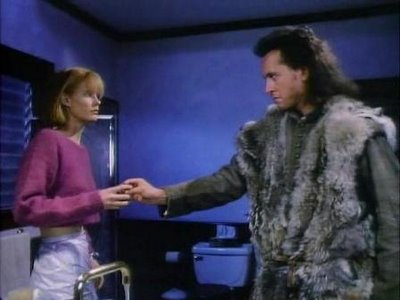
In the 17th century, an evil Warlock (Julian Sands) is sentenced to death. Before the expert witch-hunter Giles Redferne (Richard E. Grant) can carry out the sentence, however, the Warlock opens a rift in time and space that transports them to Los Angeles in the late 1980s. Clearly the Warlock is a man of fashion before his time when you consider that his dress and behaviour raise so few suspicions in 1989 despite the fact that he literally crashes through someone's window. Surrounded by other 80's hipsters, the Warlock's ponytail, shoeless feet, and black frock seem ultra-modern. It's even hard to distinguish the Warlock from other late 80's yuppies. Both are arrogant, pretentious, and self-serving, but whereas 80's yuppies might be violent while on a coke bender, the Warlock is wicked by definition: he lives to curse and kill people who get in his way. His satanic mission: locate the separated pages of the Grand Grimoire, an evil book that contains the true name of God. If spoken in reverse, the name of God will reverse all of creation. It's up to ditzy Kassandra with a 'k' (Lori Singer) and time-displaced witch-hunter Redferne to stop him. What begins as a promising supernatural thriller devolves into a dumb road movie full of lame time travel jokes and a story that is more interested in developing a lame-duck romance than any kind of horror.

Rating: 2.5 / 5 Witch Compasses


IS IT SHOCKING?

Slightly. In terms of violence, the Warlock manages to do his fair share of damage. Basically, the Warlock is pretty much a dick: he'll kill you just for the fun of it. Some tongues are ripped out and some eyeballs plucked, but the extreme violence (the killing of a child) happens off screen. Most of the time Sands is on screen as the Warlock he's not terribly scary. Prissy and hammy, the Warlock starts to lose credibility the moment he floats through the air like Peter Pan and is hampered by a weather vane. The mild horror he wrought is essentially negated. Something tells me he's not Hogwart's material.

The Warlock only has eyes for you
IS IT SILLY?

Exceptionally. First of all, the film spends way too much time trying to develop an awkward love connection between Kassandra and the hairy-vested Redferne. He's a fish out of water in the modern world, but hilarity does not ensue when movie tries to turn Kassandra from a self-absorbed and annoying airhead into a viable love interest for Redferne by making her bond with Redferne over his bewilderment at modern technology. These scenes completely drag and essentially killed this movie for me.
The Past and Future of Fashion Crime
 On top of this flat romance, Redferne spends much of the film illustrating a number of silly old-world rules about witches and warlocks with which to fight Julian Sands. On the one hand, it's neat that the film abides by (and surely invents) some archaic beliefs about witches (such as that milk curdles in their presence). This gives Redferne plenty of avenues for tracking the Warlock. On the other hand, these same rules also make the Warlock vulnerable to a silly degree. No matter how strong he becomes, he's extremely vulnerable to salt. Just plain old salt. Dump a bucket of tears on him. Push him into the ocean. Trick him into eating french fries at McDonald's. All this will all kill him. How scary or impressive can a villain be when the very powers of Satan he wields can be bested by one of the most common of all food seasonings?
------------------

For a movie about a killer man-witch, Warlock is insufferably dull. If not for the somewhat quirky witchcraft rules and the mildly amusing violence that follows in the Warlock's path, Warlock would be a complete pass. As it stands, however, the Warlock could stand to take a seriously harsh lesson from Voldemort in what it means to be a real bad ass magic man.

April 18, 2011

Insidious (Review)

Insidious (2010

Director: James Wan

I love a good ghost yarn. However, after Poltergeist, The Changeling, The Amityville Horror, and countless other films including the influx of Japanese ghost stories like The Ring, is there really any new ground to be broken in the sub-genre?  Insidious, the new horror film from Saw collaborators James Wan and Leigh Whannell, was finally released this year, and it proves that, yes, we shouldn't give up the ghost yet.

While the story is not startlingly original, Insidious rearranges the time-tested conventions of the haunting story into a smart, tight, and expertly manipulative "boo-machine" fine-tuned to get you jumping out of your seat. Insidious is a relatively bloodless film compared to recent gore fests but will nevertheless get your blood pumping with an even deeper sense of dread.

SYNOPSIS


Looking for a new start, Josh and Renai Lambert (Patrick Wilson and Rose Byrne) move their family of three children into a brand new home, but soon they encounter a very old and insidious evil. At first, things start slow. Books fall from bookshelves and items do not remain where they are left. Things only get worse after their son Dalton (Ty Simpkins) falls and bumps his head while exploring in the attic. He seems okay at first, but the next morning he doesn't wake up. The doctors are baffled. For lack of a better term, Dalton appears to be in a coma, yet there's no brain damage. As Josh, Renai, and their other young boy struggle to come to terms with Dalton's condition, the family is plagued by a series of increasingly terrifying ghostly encounters and unexplainable events that follow them from one house to the next. After they bring in a psychic medium (Lin Shaye) for help, Josh and Renai discover that the paranormal activity centers around Dalton and is connected to a hidden family secret.

Rating: 4.5 / 5 Insidious Specters

IS IT SHOCKING

Except for some blood-red hand prints left on pristine bed sheets, there's no blood to speak of in Insidious. No one is cut. No guts are pulled out of bodies. No brains are munched and no flesh is flayed. Then how shocking could Insidious be? Well, as a seasoned horror-viewer, let me say that I can't remember the last time a horror film got me to jump out of my seat until I saw Insidious. And I'm talking about an honest jump; I don't count cheap jump scares in which slashers or monsters lunge at the camera and loud musical stings assault your eardrums. Yes, Insidious, managed to spook me -- honestly and genuinely spook me -- with its creepy atmosphere, expert editing, and startlingly creepy slow burn that climaxes in a series of startling reveals.

PHOTOBOMB!
 In the first two-thirds of Insidious, the art of the shock is produced by combining sound design and deliberate yet floating camera moves to draw in the audience's attention with the anticipation of scares to come. It's not what you see that's terrifying so much as what you might see. Sometimes the scene resolves itself on a mundane detail that takes on an eerie importance. Sometimes the scene resolves itself with a shocking twist of perception. Other times, the scene will explode with a truly uncanny experience. One of the film's most effective scare techniques is the reverse-jump scare: Instead of the film hitting you with an overt ghost or goblin that jumps in your face, you realize that something creepy has been lurking quietly in the frame the whole time.... Also, by setting the action exclusively within the home, Insidious exploits a host of domestic fears and scenarios. Insidious is a film that knows exactly how to shock you and manipulate your emotions without pandering.

So a Mormon and a Psychic walk into a haunted house....
In the third act, the creepy imagery and power of suggestion become more overt, and the story takes a turn away from horror into dark fantasy, but this change of pace works in its favor. I felt the haunted house full of "boo" moments was losing its novelty; eventually I was craving answers, resolution, and then catharsis. While Insidious changes its pace to pull back the curtain on the ghostly mysteries and place the story within a detailed metaphysical mythology, the catharsis remains elusive. Even when you think Insidious is wrapped up in a nice bow, it has a few more slippery tricks up its sleeve.

Aside from the "boo" moments and thrill scenes, Insidious is also extremely well-acted. Rosie Bryne and Patrick Wilson perform as extremely natural and likable parents even under stress. They fully commit to keeping the film grounded in a domestic reality even as its metaphysical plot threads begin to tighten. In this symphony of scares, without the strong cast hitting each of their character notes, the "boo" beats certainly would have fallen flat too.
--------------------

I was both incredibly surprised and satisfied with Insidious. It plays safely within the sub-genre of ghost films with all the available conventions as established by other movies, but it fixes them in a new arrangement that even managed to scare a horror junkie like me.

With the glut of remakes and reboots flooding the horror genre,  why not take a chance in the darkened theatre with an original film like Insidious? The worst that can happen is you'll begin to wonder what else is lurking unseen in the dark with you.


November 14, 2010

Tokyo Gore Police (REVIEW)

 
Tokyo Gore Police (2008) 
(Tôkyô zankoku keisatsu)

Director: Yoshihiro Nishimura

As an outsider to Japanese culture, I can only wonder what mainstream audiences in Japan think of films like Tokyo Gore Police. Do the excessive gore, sexual perversion, ultra-violence, and twisted stories feel as bizarre and fringe in Japan as they do in North America? Perhaps they're as par-for-the-course in Japan as the romantic comedy is in North America. Regardless, I can only speak for myself: Tokyo Gore Police is the most gleefully fucked up movie I've ever seen.

SYNOPSIS


Tokyo Gore Police is a Japanese action splatter film spliced with Videodrome on acid and sprinkled with a helping of Robocop's tongue-in-cheek media satire.

In future Japan, the privatized Tokyo police force attempts to apprehend and kill a strange species of mutants known as Engineers. For the most part, these mysterious Engineers appear human but are notoriously difficult to kill because they have the ability to transform any injury into weapons. A severed limb could grow back as a deadly blade. The severed legs of an Engineer may regenerate as the fanged jaws of a monster. Some even take on bio-mechanical traits with fleshy, grotesque limbs and body parts that double as machine guns. To confront this menace, Ruka (Eihi Shiina) is a samurai sword-wielding cop with a bloody knack for dispatching Engineers. While investigating a series of Engineer-related murders, she discovers that the origin of the Engineers is linked to the murder of her own father. She discovers a past of betrayal and deceit, all the way hacking and slashing a gory trail to the truth.

Rating: 4.5 / 5 Snail Strippers


IS IT SHOCKING?

You don't call a movie Tokyo Gore Police and not bring some pretty outstanding violence to the table. I've gory violent images in Tokyo Gore Police that I've never seen before. Partly because the premise is so fantastical (bloody wounds turning into even bloodier and more disgusting weapons), and partly because the film is so violent (too many decapitations, severed limbs, and melted faces to count), Tokyo Gore Police lives up to its name: a wet-dream for any gore-hound.

 High blood pressure is the #1 killer in Japan.

If you took the body-meets-metal aesthetic of Tetsuo: The Iron Man but switched out the metal with unpredictable mutating flesh a la The Thing, you may get a sense of the way bodies are treated in Tokyo Gore Police. Even as a long-time horror fan, I encountered shocking images in Tokyo Gore Police that made me gasp and question what I saw. Tokyo Gore Police is Peter Jackson's Dead Alive without the restraint.

IS IT SILLY?


At the same time, Tokyo Gore Police is not a somber grind-fest. It's almost cartoon-like in its approach to the futuristic world of Japan and its techno-samurai police force and fleshy mutant transformers. Don't confuse the gore in this film with the gore in snuff fiction like that from August Underground or by Remy Couture (whose extreme FX work has got him into hot water in Canada recently). The difference is a matter of tone. You are supposed to revel in the gore and laugh at the over-the-top blood sprays -- laugh with that gross-out reflex one gets from seeing a human face sliced off but the body stumble around like a headless chicken. 

" It's raining blood! Hallelujah, it's raining blood."

The film also has a satirical take on media and culture that extends the silliness beyond the gore and into the background of the film. As in Robocop, we often cut to spoof commercials but on Japanese television. Although real Japanese TV is widely considered weird by North Americans, the Japanese media in the world of Tokyo Gore Police is much stranger. Ads for cutely designed box-cutters cater to kids that like to cut themselves. A presenter on a home-shopping channel kills himself with a sword. An ad for a Wii-like systems shows a family participating in a video game where the goal is to torture an imprisoned man. The mixture of this black humour and satire prevents Tokyo Gore Police from being a mean-spirited film, but it is no less shocking.

IS IT SEXY?


That depends on how into body modification you are. I'm not just talking tattoos and piercings here. I'm talking about nude strippers and prostitutes who have had their nipples removed and breasts sutured with big metal staples. I'm talking about nude women who are anatomically part-snail. I'm talking girls with penises for noses.


Think twice before getting between her legs.


Because Monster Chiller Horror Theatre often dwells in the low-brow, mildly titillating full-frontal nudity is all it takes to count as sexy. If you can forget for a moment that the woman above has an alligator for a torso, then -- yes -- Tokyo Gore Police is sexy.


IS IT SURREAL?


This dude's brain has cannons sticking out of it.
I have such an explosive migraine right now.
------------------------

If everything I've shown you about Tokyo Gore Police tickles your fancy, then you'll really enjoy this example of gorified splatter action/comedy. As far as I can tell, the performances are good, the fight choreography is exciting, and the story has enough twists and turns to keep you invested in some very slightly disjointed scenes of violence or goof-ball humor. It's the gore and practical effects, however, that you'll remember most.

Don't be surprised if you get a little blood on your face just from watching.

June 4, 2010

High Tension (Review)


High Tension (2003) 
(Haute Tension)
Director: Alexandre Aja

I don't know where I heard it, but someone once said that to review a film and discuss its twist -- or to even knowledge that there is a twist -- ruins the film for anyone who has not yet seen it. Well, too bad! I can't review High Tension without discussing the twist because it was precisely the twist that took me out of the movie. For the most part, High Tension is a tense and bloody experiment in psychological terror and suspense, but it squanders its gains with a twist ending that uses a circular saw to rip a needlessly messy hole in the plot.


SYNOPSIS

Marie (Cécile De France) accompanies her friend Alex (Maïwenn Le Besco) to Alex's family home in the French country. Isolated and quiet, the home will be a perfect place for them to study. The quiet is soon interrupted when a mysterious killer enters the home and begins to slaughter Alex's family. He abducts Alex in the back of his rusty metal truck, but Marie stows away. The film ramps up into a thrilling series of cat-and-mouse torments and revenge as Marie attempts to rescue and reunite with Alex.


Rating: 3/ 5 Shyamalans


SPOILERS FOLLOW

IS IT SHOCKING

Like most of films coming out of the French horror renaissance, to call High Tension a bloody movie is an understatement. Modern French horror is known for pushing the limit in extreme depictions of violence but also psychological horror. To ensure the gore and blood looks its best, the film hired famed Italian special effects artist Giannetto De Rossi who worked on other European horror classics such as The Living Dead at Manchester Morgue and Fulchi's Zombie 2. The whole film has a violent aesthetic as if the actual film print itself had been slightly stained with blood.


Carrie must have looked like this in the cab home from Prom

But High Tension is more than just a gore movie. Per its title, High Tension is incredibly suspenseful. The killer loves to taunt and play with his victims. He's a truly menacing and misogynistic force to be reckoned with. There's a great scene in a gas station where Marie is trying to get the store clerk to call for help but the clerk enters into a conversation with the killer that is just dripping with tension. Then tension gives way to violence and the clerk is dispatched with an axe to the chest. But because the killer is so spiteful that he doesn't just leave the clerk to die of the wound. He puts his boot on the clerk's back and pushes him further down onto the axe blade. Yeah. He's not messing around.


A shave and a haircut while you sleep: two bits.

IS IT SURREAL?


The only thing surreal about High Tension is the twist ending that renders the entire film a fantasy. You see, the male killer is actually......Marie. Yup, this is that hard-to-accomplish switcheroo where the hero is actually the villain. Marie slaughtered Alex's family. Marie, we learn, is completely psychotic, obsessed with Alex, and acting out a divergent personality to be close to her. Marie also killed the store clerk and kidnapped Alex, taking her to a secluded location in the woods. There was no male killer.

In order for this to have happened, however, the majority of the films events could not have happened as we saw it if they happened at all. In fact, nothing except the last few scenes can be reliably said to have happened since everything up until that point is seen from Marie's deluded perspective. All that tension in which Marie was being stalked by the killer didn't happen in the actual narrative of the story. For example, Marie is trying to hide from the killer in Alex's house. There's a great scene where we think Marie is in the bathtub behind the shower curtain. When the killer pulls back the curtain -- she's not there. Whew. She's actually under the bed. Oh, but wait -- this whole sequence is just a red herring. It never happened. Either Marie was hiding under the bed imagining the killer was looking for her, or she was in the persona of the killer searching for a victim who did not exist. Or, the whole thing could have been in her mind while she was doing something else.

Don't worry. This probably didn't happen.

This is the problem with High Tension. A lot of time and detail is spent crafting the character of the killer, Marie, and then setting them against each other in a very satisfying killer vs. survivor girl battle. The killer is full of unique character: he drives a giant meal truck and keeps on his dashboard the pictures of other women he has killed. The first time we see the truck, he's getting a blow job from a severed head that he cruelly discards. So, if the killer is and has always been Marie, where did she get the truck if she came to country house in Alex's car? Has she killed other women or are these suggestions a fantasy? Later, when the killer leaves Alex at the gas station in his truck, Alex is forced to steal a car in pursuit of him. Since she is the killer, how does this work? Does she take Alex in the truck to the woods, walk back to the gas station, steal a car, and then drive that stolen car back to the truck?

The film's Shyamalan-twist works as a momentary shock, but it makes everything we've seen suspect and potentially just a fantasy, draining the film of its tension. While this twist can be satisfying in other films such a Phantasm because we remain identified with one central character, this twist does not work in High Tension because it's handled poorly and too much like that derided cliche ending: "it was all a dream."

--------------------

The experience of High Tension is a superb example of horror-tension. In this film, Aja shows his flair for horror that he later used in the remake of The Hills Have Eyes and hopefully will parlay into further success with his upcoming Piranha 3D.

The ill-conceived twist, however, throws away the narrative of the film for a cheap reveal that is far less interesting or compelling than the events that came before.

LinkWithin

Related Posts with Thumbnails